The surprising part of modern identity document verification is that the document itself may be the least interesting part of the attack. A 2024 industry report found a deepfake attempt reaching verification systems every five minutes, while digital document forgeries rose 244% year over year and represented 57% of document-fraud cases for the first time. The same report recorded a 1,600% increase since 2021, showing how quickly fraud has moved from altered paper to synthetic and digitally manipulated credentials. (Entrust's report on deepfake attacks and digital document forgery)
For iGaming operators, that changes the operating question. You aren't asking whether a passport looks genuine at registration. You're deciding whether a person, device, payment method, document, and withdrawal request belong to the same trusted identity, and whether the decision can withstand a regulator's review. A crypto-funded, mobile-only player expects speed, but a bonus ring expects inconsistency. Your verification design has to expose the second without punishing the first.
Table of Contents
- Why Operators Are Treating Verification as a Front-Line Defense
- How the Core Verification Methods Actually Work
- Choosing Between Vendor, API, and In-House Builds
- Reading Accuracy Numbers Without Getting Burned
- Designing the Verification Flow Inside Your Platform
- Where Strict Scrutiny Quietly Costs You Players
- Regulatory Expectations Operators Cannot Afford to Miss
- Treating Verification as an Ongoing System
Why Operators Are Treating Verification as a Front-Line Defense
At 09:00 on a Tuesday morning, a Champions League fixture drives a wave of traffic into the cashier. Forty new accounts arrive in quick succession. They use different email addresses, slightly varied names, and fresh payment wallets, but they all claim the same promotional offer and begin moving toward withdrawal before placing meaningful bets.
A weak onboarding process may accept a clear image of a government ID, extract the name with OCR, and approve the account. It won't necessarily identify that the same face has appeared in multiple selfies, that the MRZ conflicts with the printed data, or that several accounts present the same underlying chip signature. By the time the operator sees the pattern, the ring has consumed bonus funds, created payment disputes, and generated a suspicious activity workload.
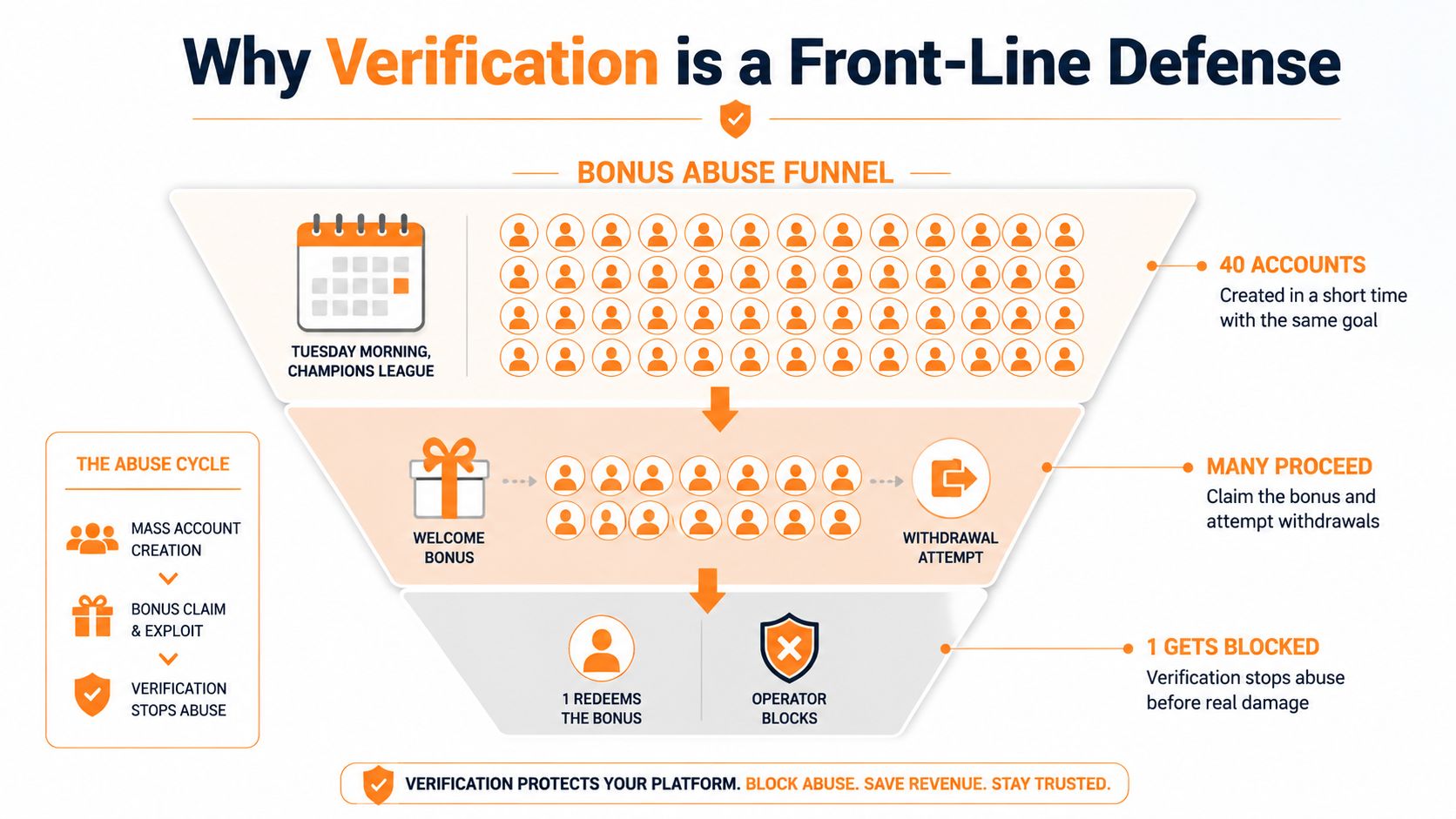
The lesson isn't that every new player needs a forensic investigation. The lesson is that identity document verification must produce reusable intelligence, not just a green status at signup. A document decision should connect to the account profile, device signals, payment behavior, bonus history, and later withdrawal events.
The market already reflects this shift. UK government analysis counted 270 active digital identity firms in 2023/2024, generating £2.05 billion in annual revenue, £858 million in GVA, and 10,813 FTE jobs. A later 2025/2026 update counted 275 firms and £2.027 billion in annual revenue, with 75% of providers involved in identity or attribute verification. (UK digital identity market figures) Document verification is now core digital infrastructure for onboarding, fraud prevention, and regulated transactions.
Operator rule: Don't ask whether KYC passed. Ask what identity signals passed, which failed, what accounts share those signals, and whether the answer still holds at withdrawal.
Build the control into your wider risk management practices. At first deposit, use the document to establish a trusted identity. At a material withdrawal, compare the new evidence with the original record. When a player changes a device, payment instrument, or personal details, let the risk engine decide whether a fresh selfie, MRZ read, or manual review is warranted.
That approach protects more than the bonus budget. It gives compliance teams a defensible explanation for decisions, gives fraud analysts linked evidence instead of isolated alerts, and preserves goodwill with legitimate players who shouldn't have to repeat the full process every time they log in.
How the Core Verification Methods Actually Work
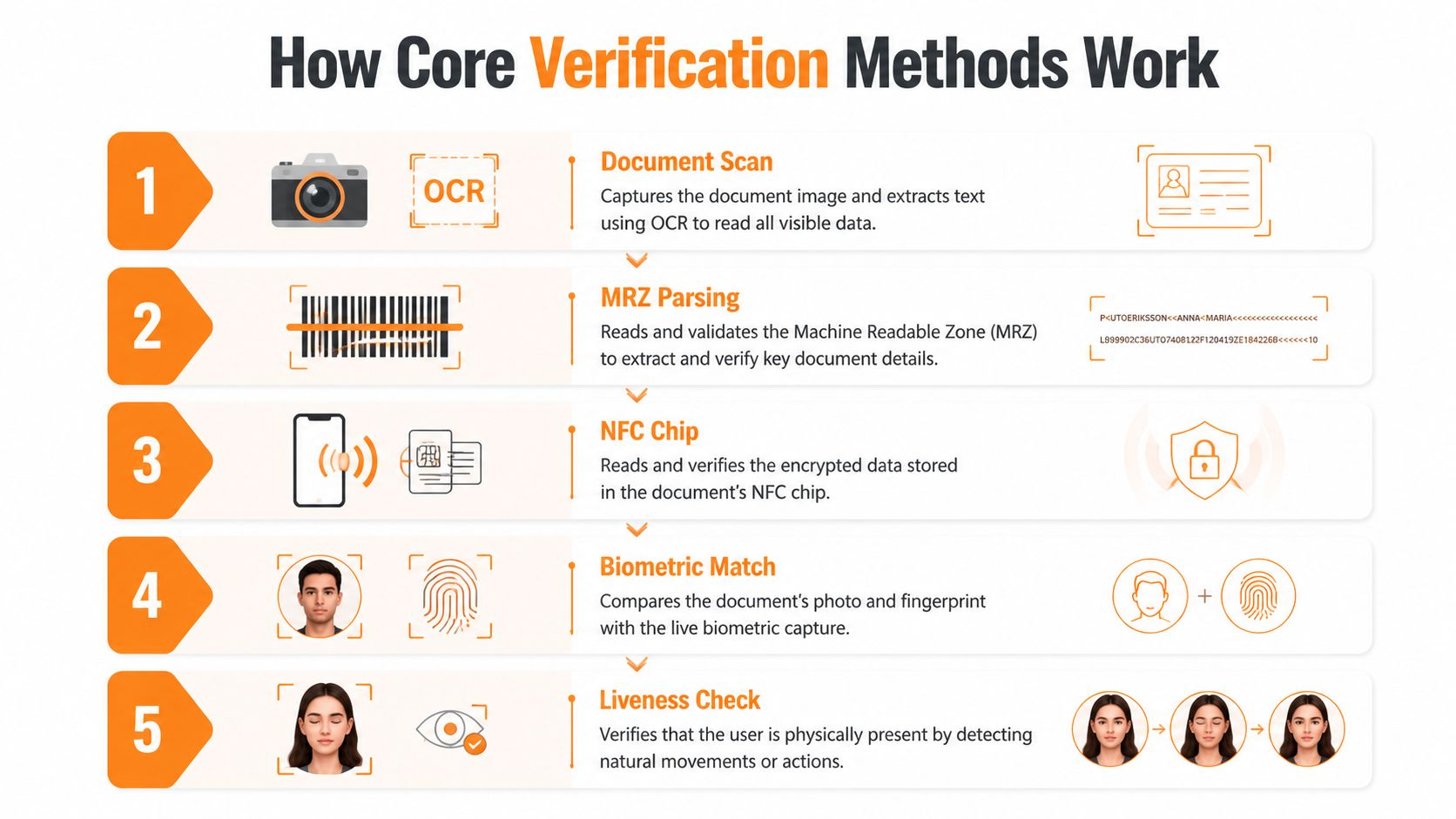
A reliable flow is progressive. Each layer answers a different question, and none should be treated as sufficient on its own.
Start with the document image
The camera capture produces an image for document classification, OCR, visual inspection, and tamper analysis. OCR extracts names, dates, document numbers, and other fields, while classification identifies the document type and expected layout.
OCR is fast and useful, but it only tells you what the submitted image appears to contain. It doesn't prove that the document is genuine or that the presenter owns it. Use it at account creation and let the result populate the player profile, but keep authenticity and identity ownership as separate decisions.
Read the MRZ before trusting the printed fields
The machine-readable zone provides structured access data and a consistency check against the visual page. A mismatch between the printed name, date of birth, document number, and MRZ should route the case to rejection or review, not disappear into an OCR confidence score.
MRZ parsing is particularly valuable when a bonus-abuse group modifies images or submits credentials that look plausible at a glance. It adds a structured signal with little player effort, especially when the mobile capture experience guides the user correctly.
Use NFC where the document supports it
NFC validation is a cryptographic process for ePassports and other ICAO-compliant documents. The verifier captures the MRZ, uses the access data to read the chip, and performs PKI checks including Active Authentication, Document Signature Validation, and Country Signature Validation. (ReadID's explanation of NFC identity document verification)
The chip can provide biographic and biometric fields that the system compares with the printed data page and a live selfie. That makes NFC valuable at a high-risk withdrawal or after suspicious session behavior. It isn't a replacement for biometrics, and it won't help when a document lacks a readable chip or the player's phone can't complete the read.
Match the face, then test presence
Face matching compares the live capture with the document portrait. Liveness testing addresses presentation attacks such as a photograph, replayed video, mask, or manipulated portrait. Active liveness asks the player to perform an action, while passive liveness evaluates the capture without requiring a deliberate movement.
The tradeoff is operational. OCR and MRZ checks usually add little visible friction. NFC introduces device and document compatibility issues. Biometric and liveness checks add capture time and can fail in poor lighting or on low-bandwidth mobile connections. Trigger the heavier layers when the risk justifies them, such as a first deposit, a withdrawal above your internal risk threshold, a changed device, or an unusual account cluster.
Veriff's reporting found that 4.18% of digital identity checks processed in 2025 were flagged as fraudulent, roughly one in 25 attempts. (Veriff fraud reporting covered by BetaNews) That exposure is why the stack matters. OCR catches extraction problems, document forensics catches manipulation, NFC tests issuer-backed data where available, and biometrics connect the document to the person presenting it.
Choosing Between Vendor, API, and In-House Builds
The right architecture depends less on ideology than on your launch constraints. A mid-market operator with multiple jurisdictions, casino and sportsbook products, crypto payments, and a small compliance engineering team usually shouldn't build the verification pipeline from scratch. The integration burden sits in the cashier, player account system, risk engine, support tooling, reporting layer, and audit store, not just in the camera screen.
| Pattern | Best fit | Strengths | Weaknesses |
|---|---|---|---|
| Full-service KYC vendor | Operators prioritizing speed and broad coverage | Prebuilt workflows, document libraries, biometric tools, review operations, and compliance support | Less control over user experience, decision logic, and vendor pricing |
| API-first document specialist | Product-led teams with strong engineering resources | Flexible orchestration, custom triggers, modular checks, and easier provider substitution | Your team owns more integration, monitoring, fallback logic, and operational review |
| In-house pipeline | Large operators with unusual scale, mature fraud teams, and durable engineering capacity | Maximum control over data, rules, player journeys, and internal intelligence | High build and maintenance burden, specialist staffing needs, and continued coverage obligations |
A turnkey platform pays for itself when the cost of launching late, managing several integrations, and supporting manual exceptions exceeds the premium for an integrated workflow. API-first wins when you already have a mature risk engine and want to choose separate providers for OCR, NFC, biometrics, sanctions, and review. In-house becomes justifiable only when verification is a strategic capability and you can maintain document coverage, model evaluation, security, and regulatory evidence over time.
Use a simple decision rubric:
- New brand with a narrow license footprint: Start with a full-service provider and demand clean webhooks, exportable evidence, configurable policies, and a documented fallback path.
- Existing operator entering several markets: Use an API-first design if your account, wallet, and risk systems can own orchestration without creating inconsistent decisions.
- Large multi-brand group: Consider selective in-house orchestration, while retaining specialist providers for document coverage, biometric checks, and high-risk review.
Vendor selection also belongs inside your vendor management process. Review data residency, subcontractors, service continuity, manual-review quality, incident response, and exit terms before comparing per-check prices.
Reading Accuracy Numbers Without Getting Burned
“Accuracy” is an incomplete buying metric. A provider can report strong document classification while still producing weak field extraction, permissive liveness decisions, or biometric thresholds that create unacceptable false matches. Operators need the underlying measures and the cost of each error.
A false negative blocks a legitimate player. That can mean a failed withdrawal, a support contact, an abandoned account, or a manual review queue. A false positive approves a fraudulent identity. That can expose the operator to bonus abuse, payment loss, AML concerns, and license risk.
Test the workflow as a decision system, not a polished demo. Build a controlled adversarial set containing expired IDs, low-light selfies, glare, cropped documents, inconsistent fields, screen replays, synthetic portraits, and known account-link patterns. Ask the vendor to explain the result for every case and to expose enough evidence for your compliance team to reproduce the decision.
| Metric | What It Measures | Risk If Too Loose | Risk If Too Tight |
|---|---|---|---|
| Document classification accuracy | Whether the system identifies the document type and expected structure | Unsupported or manipulated documents enter later stages | Valid documents are rejected before useful checks run |
| Field-level OCR confidence | Reliability of extracted personal and document data | Bad data contaminates screening and account matching | Players repeat captures for harmless image-quality issues |
| Biometric match score | Similarity between the live face and document portrait | Impostors or related faces may pass | Legitimate players fail because of age, lighting, or image differences |
| Liveness pass rate | Whether the capture represents a live person rather than a presentation attack | Replay and synthetic-face attacks receive approval | Mobile users abandon after repeated challenges |
| Manual-review rate | Volume requiring human intervention | Hidden operational cost and slow withdrawals | Excessive escalation damages conversion and support capacity |
| Time-to-decision | Speed from submission to actionable result | Teams may bypass controls to protect service levels | Players wait, contact support, or move to another operator |
Track precision, recall, manual-review rate, abandonment, and time-to-decision separately. Don't let a single blended score decide your contract. Set thresholds by risk tier, then review performance by jurisdiction, document type, device, traffic source, and transaction stage.
Practical test: Price every error in operational terms. The right threshold is the one that manages fraud exposure and player loss together, not the one that looks strongest in a vendor presentation.
Designing the Verification Flow Inside Your Platform
Registration is a poor place to demand every piece of identity evidence. Players are still deciding whether to fund an account, and many haven't reached a regulated transaction that justifies heavy intervention. Start with low-friction signals, then escalate when the player's behavior or transaction creates a clear reason.
Progressive profiling can capture email, phone, device, payment fingerprint, location, and account details early. The operator can trigger document verification at the first deposit, a withdrawal request, an account change, or another policy-defined event. High-risk sessions can move directly to NFC or video liveness, while trusted returning players can authenticate with a lighter step.
Give each journey its own policy
A sportsbook player placing a first wager doesn't necessarily present the same pattern as a casino player requesting a rapid withdrawal. A poker account may need stronger account-link analysis because several users can appear connected through shared tables, devices, or payment behavior. Jurisdiction, product, age requirements, payment method, and risk score should all influence the branch.
The orchestration service should return a clear state such as pending, approved, rejected, or manual review. Store the reason codes and evidence references with the player profile, not only in a vendor dashboard that support agents can't access.
Engineer for failure, not just the happy path
A vendor SDK can time out. A player can lose connectivity halfway through NFC capture. A camera permission can fail, or a document can be unreadable because of glare. Your platform needs resumable sessions, idempotent callbacks, status webhooks, and a safe cashier state that prevents withdrawal release while a required check remains unresolved.
Support should see plain-language next actions. “Move to a brighter room and keep all four corners visible” is useful. “Verification failed” isn't. Allow the player to retry the failed component without restarting the entire flow, and provide an alternative route when the primary method isn't compatible with the device or document.
The best flow makes routine verification nearly invisible and concentrates friction on anomalies. That requires a shared risk view across onboarding, deposits, withdrawals, login events, account changes, and ongoing monitoring. A green KYC result should be a starting point for controlled access, not a permanent exemption.
Where Strict Scrutiny Quietly Costs You Players
Stricter checks don't automatically create safer operations. They can create more abandonment, more support tickets, and more pressure on players to use competitors with weaker controls. The mistake is applying the same burden to every session after the basic risk has already been resolved.
A document-quality problem accounts for roughly 36% of incomplete verification sessions, according to recent reporting. (Zyphe's reporting on digital identity verification trends) That points to a practical failure: operators may be losing legitimate users because the capture experience is unreliable, not because the fraud policy is insufficient. The same reporting notes that liveness retry exhaustion and address mismatches are also prominent failure causes.
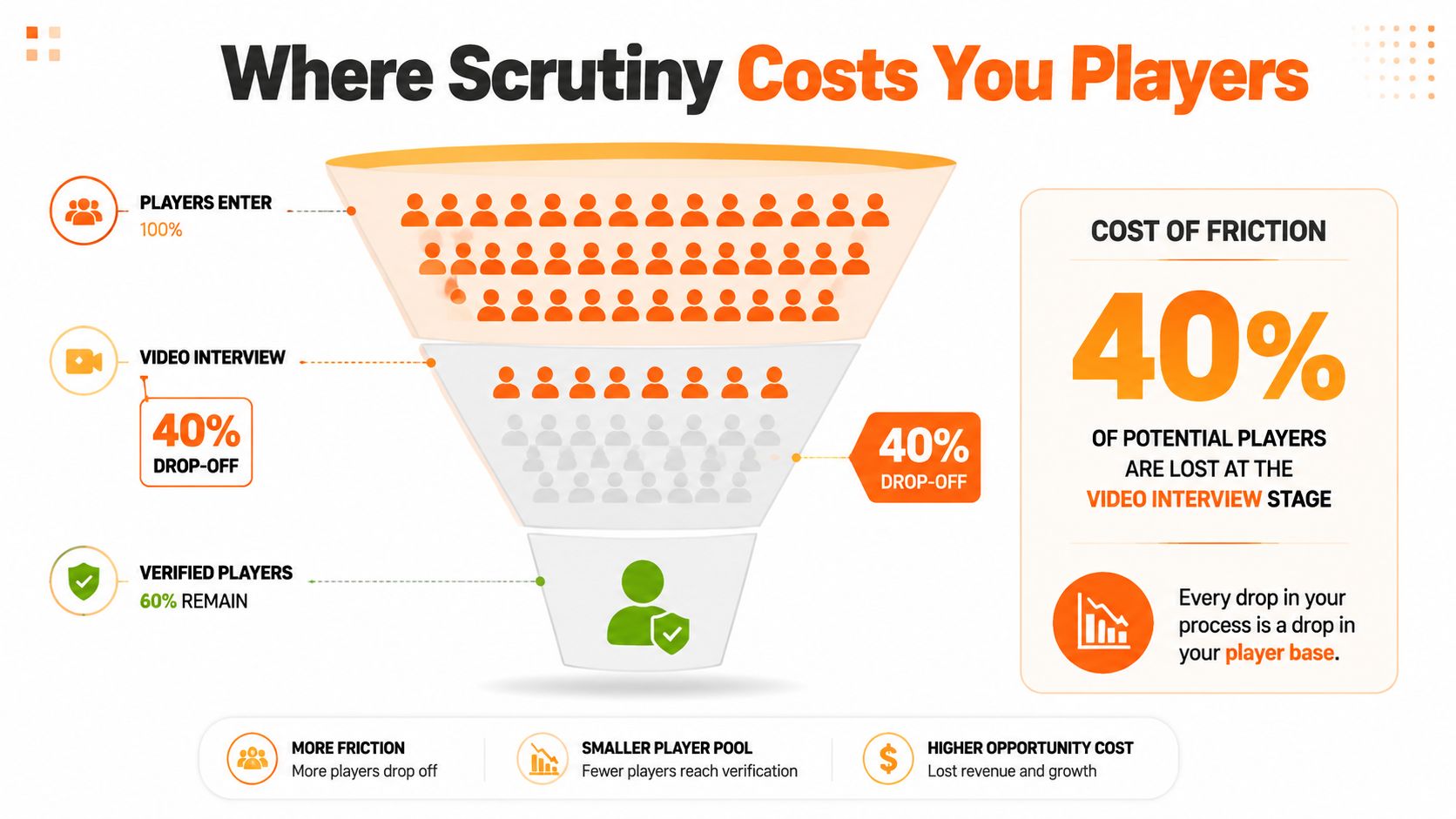
A video interview, in-person proof requirement, or second government ID may be justified for a high-risk case. It isn't a sensible default for every player requesting a routine withdrawal. Crypto-funded users are especially sensitive to delays because they expect wallet-level speed, but speed doesn't mean the operator should remove controls. It means the system should reserve the slowest controls for the cases that need them.
Use a tiered model:
- Low-risk session: Reuse a trusted identity record, confirm device and account continuity, and avoid unnecessary document recapture.
- Changed or unusual session: Ask for a fresh selfie, document recapture, or payment ownership evidence based on the specific anomaly.
- High-risk withdrawal: Require stronger document authentication, NFC where supported, liveness, and human review before release.
Measure the conversion impact of every escalation. Compare fraud capture with retry rates, support contacts, withdrawal delay, and account abandonment. NFC can help where supported because cryptographically verified chip reads were reported to reduce time-to-decision by 30% to 50%. (Zyphe's report on NFC and verification trends)
The goal isn't leniency. It's targeted scrutiny. Protect the license without making legitimate players prove the same fact repeatedly.
Regulatory Expectations Operators Cannot Afford to Miss
Regulatory obligations become manageable when you translate them into product rules. The license doesn't care whether a check lives in a vendor dashboard or your own risk engine. It cares whether you identify the customer, understand the risk, apply enhanced due diligence when required, screen against relevant lists, retain defensible evidence, and explain decisions.
Set policy triggers before implementation. A withdrawal threshold, unusual payment pattern, account change, adverse screening result, or linked-account signal can move a player from standard verification to enhanced review. Don't wait until the player reaches the cashier to discover that your system can't distinguish an ordinary reverification from an enhanced due diligence case.
| Regulator Expectation | Verification Design Choice | Practical Threshold |
|---|---|---|
| Customer identification and age or identity controls | Define accepted documents, capture requirements, matching rules, and decision states by jurisdiction | Registration, first deposit, or another policy-defined onboarding event |
| Risk-based enhanced due diligence | Route high-risk players to stronger document, biometric, source-of-funds, or manual checks | Risk score, unusual transaction, adverse screening, or linked-account alert |
| PEP and sanctions screening | Screen at onboarding and re-screen when profile or risk data changes | Before access to regulated activity, then on defined events and monitoring cycles |
| Record keeping and auditability | Preserve decision reasons, submitted evidence, reviewer actions, timestamps, and policy versions | Throughout the retention period required by the applicable license |
| Ongoing customer risk management | Reverify when risk changes rather than relying on a permanent KYC pass | Withdrawal, material account change, or periodic review trigger |
Do not hard-code one global rule for every market. The UKGC, MGA, and FATF-style risk-based expectations can overlap, but local implementation, affordability controls, reporting duties, retention requirements, and supervisory priorities differ. Compliance should own the policy matrix, while product and engineering turn it into versioned workflow logic.
Your audit trail should answer five questions quickly:
- What did the player submit?
- Which checks ran?
- What signals passed or failed?
- Who or what made the decision?
- What policy was active at that time?
Keep biometric and document data only as long as your legal and regulatory framework permits or requires, and document deletion and access controls. Connect the evidence to your compliance reporting process, so regulatory submissions and internal investigations rely on the same source of truth.
Treating Verification as an Ongoing System
A player's identity risk changes after onboarding. The device changes, payment methods change, account behavior changes, and fraud rings adapt after a failed attempt. A one-time KYC gate can't capture that movement.
Build a continuous control surface around the player account. Onboarding establishes the initial identity record. Withdrawal-time reverification tests whether the person requesting funds still matches that record. Periodic re-KYC refreshes stale evidence, while behavioral monitoring can trigger a new selfie, MRZ read, NFC check, or manual review.
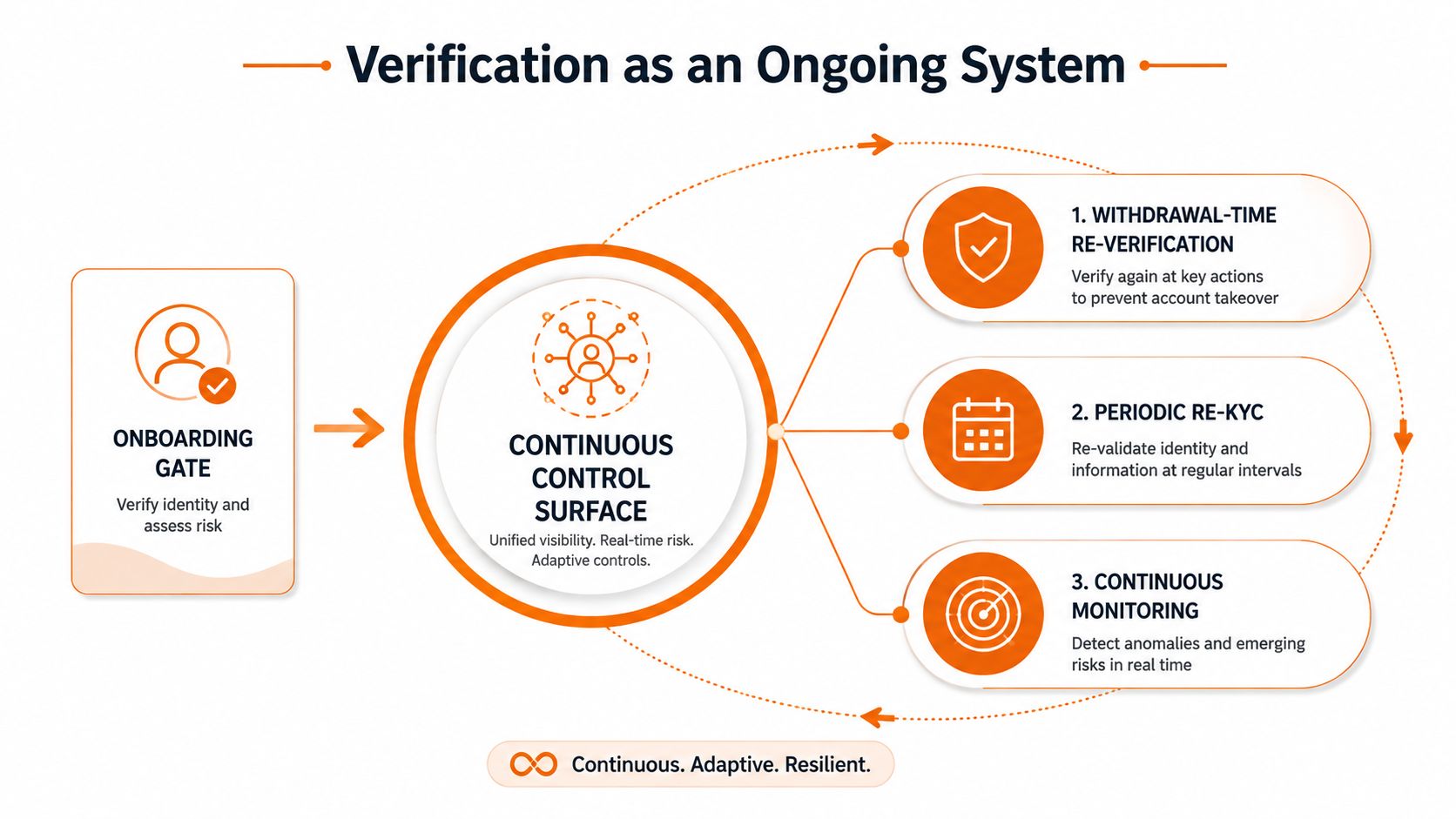
The orchestration layer should make those decisions dynamically. A trusted player returning from the same device can move through a low-friction authentication path. A new device combined with a payment change can demand stronger evidence. A withdrawal that conflicts with the established profile can pause release without forcing every other player through the same process.
This architecture also improves economics. Layered signals reduce reliance on any one imperfect check, automated rechecks reserve human review for meaningful exceptions, and clear failure handling protects support capacity. Industry commentary projects biometric checks to rise from 32.2 billion in 2026 to 70.1 billion in 2030, while traditional document verification is expected to grow more slowly. (Regula's 2026 verification trends) The direction is clear, but operators should adopt biometrics as part of an orchestrated control, not as another isolated gate.
Verification should be runtime infrastructure. If the risk engine can't request the right evidence at the right moment, the operator is still running a static compliance form.
NexGrate provides a white-label iGaming platform with KYC and fraud controls integrated across player accounts, wallets, payments, casino, sportsbook, and back-office operations. If you're launching or rebuilding an iGaming brand, visit NexGrate to discuss how its integrated compliance and cashier architecture can support layered identity document verification without adding avoidable friction.