
You're probably in one of two positions right now. You either have a brand concept, a market angle, and a budget, but no clear view of the technical and regulatory path ahead. Or you've already talked to a few vendors, heard terms like PAM, aggregator, odds feed, and white-label, and realized that launching a betting site is less about a website and more about building an operating business.
That's the right way to think about it.
A betting brand can look simple from the outside. A clean lobby, live odds, payments, bonuses, and support. Behind that front end sits a licensed operation with rules for onboarding, payments, fraud, responsible gaming, reporting, and settlement. If any one of those breaks, the business feels it immediately.
The opportunity is large. The global online betting market was valued at approximately $78.3 billion in 2022 and is projected to reach $187.5 billion by 2030 at a CAGR of 11.5%, according to this market growth reference. But scale cuts both ways. Big markets attract capital, regulators, faster competitors, and players with high expectations.
If you want to understand how to make a betting website that can launch and survive, start with the first decision most founders underestimate. Don't start with design. Don't start with bonuses. Start with the build model.
Table of Contents
- From Dream to Reality in the iGaming Market
- The Foundational Decision White-Label vs Custom Build
- Navigating the Regulatory and Licensing Maze
- Architecting Your Platform Tech Stack and Integrations
- Running the Business Operations Risk and Security
- Go-to-Market and Player Retention Strategies
From Dream to Reality in the iGaming Market
Most founders begin with the visible part of the business. Brand name. Domain. Market focus. Sportsbook, casino, or both. They imagine launch day, affiliate deals, and players funding wallets within hours.
That vision matters. It gives the project direction. But in iGaming, the brand only works if the machinery behind it is ready for pressure.
The reason so many early plans go off course is simple. Founders treat a betting site like a digital product launch, when it's closer to launching a regulated financial platform with entertainment wrapped around it. A sportsbook has to price markets correctly, lock odds at the right moment, settle accurately, block restricted regions, verify users, and process withdrawals without friction. A casino has to do the same while managing wallet behavior, game provider integrations, bonus abuse, and transaction review.
A betting website doesn't fail because the homepage looked bad. It fails because the operation underneath couldn't support what the homepage promised.
That's why learning how to make a betting website starts with business architecture, not page wireframes. Your real questions are harder. Are you entering quickly with a controlled product scope, or building for deep ownership over time? Are you licensing into a strict market, or using a lower-friction jurisdiction while preparing for expansion? Are you set up for fiat, crypto, or both?
Why the first months matter more than the launch announcement
A weak launch can be fixed. A weak foundation usually can't be fixed cheaply.
Operators who rush into development without clarifying their licensing path, wallet structure, game and sportsbook stack, and back-office workflows end up rebuilding expensive parts later. That rebuild usually touches payments, KYC, reporting, or settlement logic. Those are the worst systems to redo after users and regulators are already involved.
A practical launch plan has to answer four things early:
- Build path: White-label or custom.
- Regulatory path: Which jurisdiction you can support operationally.
- Commercial scope: Casino only, sportsbook only, or unified wallet across both.
- Operating model: Who handles support, fraud review, payments, and ongoing compliance.
That's where the core work begins.
The Foundational Decision White-Label vs Custom Build
This is the decision that shapes every other one. If you get it wrong, you'll spend money solving the wrong problem.
A custom build sounds attractive because it promises control. You choose the front end, define the wallet logic, shape the player journey, and own the roadmap. If you have a strong internal product team, deep capital, and patience, that path can make sense. You're building a proprietary asset.
Most new operators don't need a proprietary asset on day one. They need a launchable business.
Why this decision comes first
The biggest trade-off is time. Custom development often exceeds 12 to 18 months, while turnkey white-label solutions can reduce launch timelines to 3 to 6 months by pre-integrating key systems, based on this sports betting website development breakdown. That gap changes everything. It affects licensing sequence, hiring, payment onboarding, affiliate planning, and how long your capital sits idle before revenue starts.
Custom also means you inherit integration risk. You don't just build a front end and a back end. You coordinate game studios, sportsbook feeds, payment providers, KYC vendors, fraud tools, CRM logic, geolocation controls, and reporting. Every vendor introduces timelines, edge cases, and support dependency.
White-label takes the opposite view. You accept some limits on deep customization in exchange for speed, tested integrations, and a stack that's already structured for operation. For most first-time operators, that's not a compromise. It's good prioritization.
If you want a side-by-side view of the strategic trade-offs, this platform comparison for operators is the kind of checklist worth using before you commit.
White-Label vs. Custom Build At a Glance
| Factor | White-Label Platform | Custom Build |
|---|---|---|
| Launch speed | Faster because the core systems are already connected | Slower because each system has to be designed, integrated, and tested |
| Upfront complexity | Lower. The architecture is mostly predefined | Higher. You manage product scope and technical dependencies from scratch |
| Control over roadmap | Limited to what the platform supports and what the provider allows | Much higher control over features, workflows, and data structure |
| Compliance workload | Easier if the platform already supports reporting, KYC, AML, geofencing, and responsible gaming tools | You still own compliance, and you also have to make the systems support it correctly |
| Vendor management | Fewer moving parts if content, payments, and back office are bundled | More contracts, more integrations, more failure points |
| Long-term flexibility | Good for fast market entry and brand validation | Better if you're building a larger technology business, not just an operator brand |
What usually works for new operators
New brands often overestimate how much custom product differentiation they need at launch. Players rarely join because your cashier logic is unique. They join because the brand is credible, the product is stable, payments work, odds are competitive, and withdrawals don't create anxiety.
What doesn't work is building custom infrastructure to solve problems you don't have yet.
A sane rule is this:
- Choose white-label if your priority is speed, licensing support, integrated payments, and operational simplicity.
- Choose custom if you already know which parts of the stack must be proprietary, and you can absorb a longer runway before launch.
- Avoid hybrid confusion where you claim to build custom, but still rely on several external systems stitched together without a clear owner.
Practical rule: If your team can't name who will own settlement logic, KYC workflows, payment reconciliation, and provider incident handling, you're not ready for a custom build.
Learning how to make a betting website isn't about picking the most ambitious route. It's about choosing the route your business can operate well.
Navigating the Regulatory and Licensing Maze
A common early mistake looks like this. A founder picks a jurisdiction because the fee looks manageable, signs a platform deal, starts design, and only then learns the chosen setup cannot support the required KYC rules, reporting format, payment controls, or restricted-market logic. That mistake is expensive on a white-label. It is worse on a custom build, where every gap becomes a product ticket, a legal risk, or both.

Licensing affects far more than market access. It determines how you register players, what payment methods you can support, how bonus funds are tracked, when withdrawals are paused, what records must be retained, and how support handles disputes. For a new operator, this is the point where the white-label versus custom decision starts showing its consequences.
Licensing is an operating model decision
The more practical questions are harder. Can your team pass ongoing compliance reviews? Can your platform produce clean audit trails? Can finance reconcile transactions the way the regulator expects? Can your provider stack support market restrictions without manual workarounds?
Jurisdictions differ less by headline appeal than by the amount of operational discipline they demand. The UK and Malta generally require stricter player protection, auditability, and reporting than lower-friction offshore options. New Jersey and other regulated US states add another layer through state-specific controls, approvals, and supplier dependencies. The licensing section in this gambling compliance guide is a useful reference point for the kind of obligations regulated operators are expected to meet.
That is why the licensing choice should follow the business model, not the other way around. A white-label can shorten the path if the provider already has approved controls, reporting workflows, and jurisdiction experience. A custom build gives more freedom, but it also means your team owns the gaps. If your compliance logic lives across spreadsheets, payment-provider rules, and support macros, you do not have a licensing strategy. You have operational debt.
What regulators force you to build
Regulators look for control, traceability, and player protection.
That changes the product in specific ways:
- KYC and AML workflows must verify identity, flag suspicious activity, and route exceptions for review without creating a broken deposit journey.
- Geofencing and market access controls must block restricted users consistently across web, app, affiliates, and payment flows.
- Responsible gaming tools must support deposit limits, cool-off periods, self-exclusion, and visible account controls.
- Audit logs and reporting records must show who did what, when it happened, and how the decision was made.
These are not legal extras added after launch. They shape registration, wallet logic, bonus handling, withdrawals, fraud review, and customer support from day one. Operators comparing vendors should inspect the control layer closely. This gambling compliance tooling overview shows the kind of built-in monitoring and workflow support that matters once licensing reviews begin.
One practical test helps here. Ask the vendor to show how a suspended account, a source-of-funds review, and a self-excluded player are handled across the back office, payments, CRM, and support screens. Sales teams that cannot demonstrate those flows usually expect your operations staff to patch the process manually.
Compliance debt usually starts with one shortcut. Deferred KYC, weak geoblocking, unclear wallet rules, or missing logs. Under review, each shortcut turns into delay, rework, or exposure.
This short video is useful if you want a practical sense of the legal side before vendor conversations get too far ahead of you.
Why crypto-first operators get blocked early
Crypto-first products face a harder compliance fit because the wallet design often gets defined before the licensing model does. That sequence creates problems fast. A regulator may accept digital assets in one form, reject anonymous flow assumptions, or require stronger traceability than the original cashier design can provide.
The usual failure points are clear:
- Onboarding logic does not match the market. One jurisdiction permits lighter checks at registration, another requires stronger verification before meaningful account activity.
- Wallet architecture treats crypto and fiat as separate systems, which complicates limits, bonus accounting, reconciliation, and source-of-funds review.
- Location controls are applied inconsistently, so users can enter through one channel and fail checks later at deposit or withdrawal.
For crypto-first casinos and sportsbooks, compliance has to shape the wallet, payments, and user journey from the start. White-label platforms can reduce that burden if the provider has already solved chain monitoring, KYC orchestration, sanctions screening, and jurisdiction rules. Custom builds make sense only when you know why the extra control will produce commercial upside, and you have the legal, payments, and risk teams to support it.
Architecting Your Platform Tech Stack and Integrations
A new operator usually focuses on what players see first. The homepage, the sportsbook lobby, the casino tiles, the cashier. The launch gets decided somewhere else. It gets decided in the platform layer that controls wallet logic, bet processing, provider connections, and the back-office data your teams need to run the business.
That is the practical difference between a white-label launch and a custom build. With white-label, you inherit a stack that already connects front end, wallet, content, payments, and admin tools. With custom, you choose each layer yourself and take responsibility for how those layers behave under traffic, provider errors, and settlement disputes. Common choices across modern web platforms include React or Vue on the front end, Node.js, PHP, or similar frameworks on the server side, and relational databases such as PostgreSQL or MySQL for transactional records, as described in MDN's overview of modern web technology stacks.
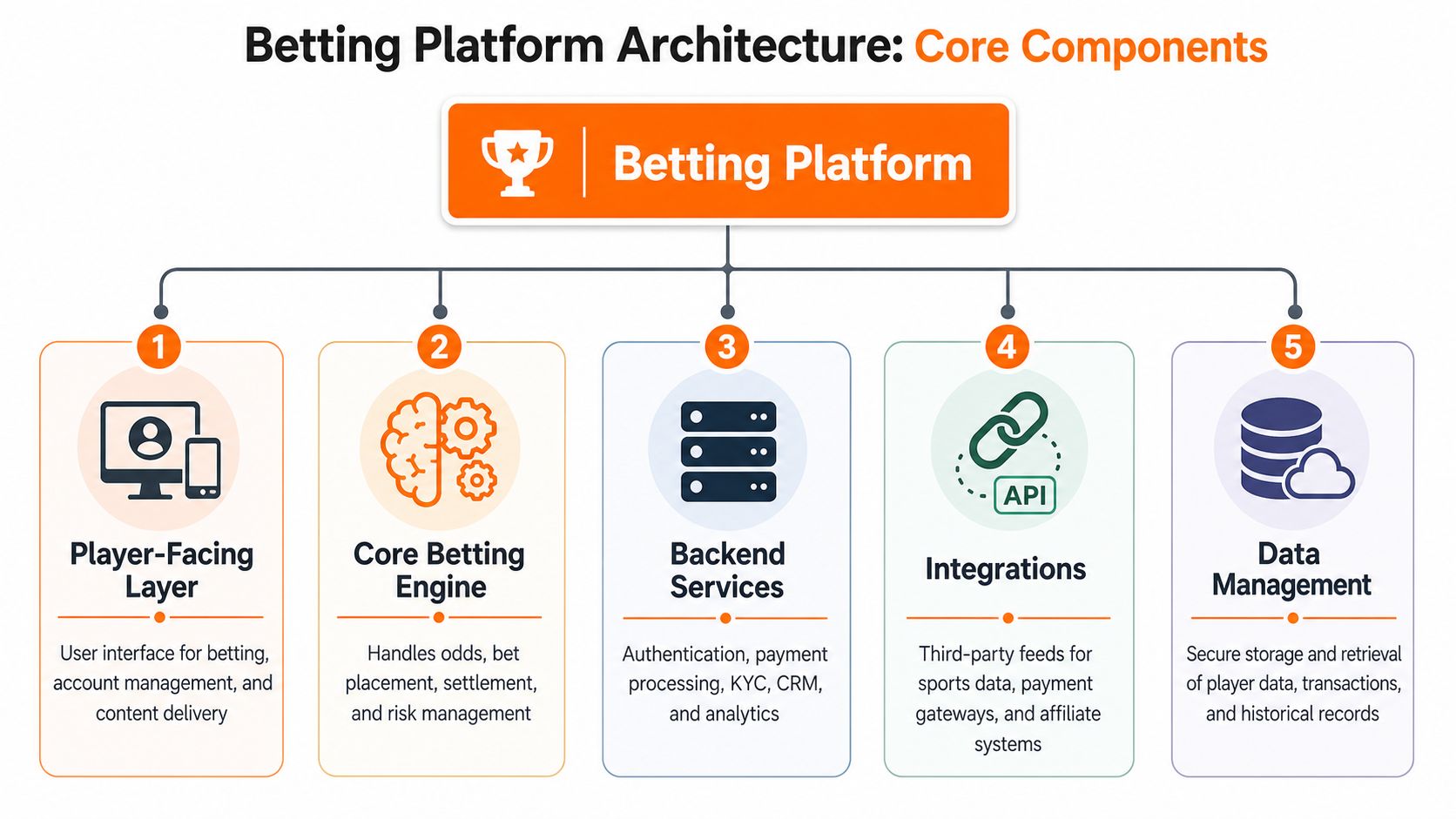
The five systems that matter
A betting operation needs five connected systems working as one product.
- Player-facing layer. The website or app handles registration, navigation, deposits, bet placement, and account management. Mobile performance matters because that is where conversion drops first.
- Betting and gaming logic. This covers odds display, bet acceptance, market status, settlement, bonus interaction, and game-session handling. In sportsbook, this layer also controls liability.
- Platform services. Authentication, wallet balances, KYC steps, notifications, CRM triggers, bonus rules, and admin permissions sit here.
- Integration layer. Odds feeds, game aggregators, PSPs, crypto gateways, geolocation tools, affiliate tracking, and fraud vendors all connect through this layer.
- Data and reporting layer. Transaction history, player records, event logs, audit trails, and operational reporting must be stored in a way your support, finance, and compliance teams can use.
For operators comparing deployment models, this iGaming platform architecture overview is a useful benchmark for what a unified stack should already include.
Integration work decides whether the product feels finished
Budgets often slip at this point.
A founder often assumes the build is straightforward. One sportsbook feed, one casino aggregator, a few payment methods, and a branded front end. In production, every integration brings its own timeout rules, callback behavior, settlement timing, retry logic, support process, and reporting gaps. If one provider sends delayed status updates or changes an API field without warning, your team handles the player complaints, not the vendor.
The integrations that usually create the most operational pressure are clear:
- Sports data and odds feeds, where latency and market-state mismatches can create pricing and acceptance problems.
- Casino aggregation, where session handling, game launches, and bonus compatibility vary by provider.
- Fiat and crypto cashier flows, where deposits, withdrawals, FX handling, and blockchain monitoring have to reconcile into one ledger.
- Unified wallet behavior, so sportsbook and casino balances, limits, and promotions work together.
- Reporting outputs, so finance, support, AML, and VIP teams see the same account history.
The right question is not whether a provider is integrated. The right question is what happens when that integration fails at 8 p.m. on a major match day.
Sportsbook architecture gets expensive fast
Casino can tolerate some delay. Sportsbook usually cannot.
Once you run live or pre-match sports at scale, technical shortcuts start showing up as direct margin loss. Bet acceptance depends on market freshness, suspension logic, and clean synchronization between the odds source and your risk rules. Event-driven systems are commonly used for this class of workload because they handle high-volume updates and decouple services under load, as explained in Confluent's event-driven architecture guidance.
For a custom sportsbook build, plan for these failure points from day one:
| System concern | What goes wrong if you ignore it |
|---|---|
| Odds ingestion | Players see stale or inconsistent prices |
| Bet acceptance timing | Bets can be accepted against the wrong market state |
| Settlement rules | Payout errors damage margin and create support volume |
| Feed failover | A single supplier issue can remove major events from the board |
| Peak-load behavior | Match-day traffic exposes queue delays, race conditions, and timeout issues |
That trade-off matters. A white-label stack limits flexibility, but it usually gives you proven integrations, tested wallet behavior, and faster launch timing. A custom stack gives you more control over product logic and supplier choice, but only if you have the engineering, trading, and operations depth to support it. For most first-time operators, pre-integrated infrastructure is the safer commercial decision.
Running the Business Operations Risk and Security
Launch day is the start of the hard part. Once players register and deposit, the business shifts from build mode to operating mode.
That's where many early operators struggle. They've budgeted for branding and development, but not for the daily control layer that keeps the platform safe and profitable.

Your back office runs the business
A betting site lives or dies in the back office. That's where support agents review accounts, finance teams reconcile withdrawals, compliance staff inspect documents, and risk teams react to suspicious behavior.
The strongest operations setups usually keep three functions tightly connected:
- Player management for onboarding checks, account reviews, support history, and responsible gaming actions.
- Financial operations for deposit monitoring, withdrawal queues, provider exceptions, and wallet reconciliation.
- Risk and fraud controls for bonus abuse, unusual betting behavior, velocity checks, and market exposure review.
If those teams use disconnected tools, decisions get slow and inconsistent. A player gets approved in one queue and blocked in another. A withdrawal gets delayed because support can't see finance notes. A risk alert fires, but nobody owns the final action.
Risk management is not a settings page
Sportbook operators often commit their most expensive mistake at this point. They treat margin and bet limits as fixed launch settings, then assume they can tune them later.
The market doesn't give them that time. Data shows 52% of new sportsbooks fail within 18 months due to unoptimized margin settings and inadequate fraud detection for in-play markets, based on this sportsbook risk management analysis.
That statistic matters because it points to a pattern. New operators usually focus on visibility and acquisition, while experienced operators focus on exposure control. They know in-play markets move fast, fraud adapts quickly, and profitable users don't all carry the same risk profile.
A practical risk stack should let operators:
- Adjust limits by player profile rather than applying one blanket rule.
- Review suspicious market behavior quickly before liabilities compound.
- Separate recreational value from exploitative activity in bonus and betting behavior.
- Trace settlement and pricing decisions when a dispute lands with support or compliance.
If your risk team can't change trading posture during live events without engineering involvement, the setup is too brittle.
Security and payments need daily attention
Security in iGaming isn't only about perimeter defense. It's tied to account access, transaction review, payout confidence, and provider resilience.
Payment operations need especially close management because that's where player trust gets tested. A delayed withdrawal, a failed deposit, or a manual review with no clear communication can undo a lot of acquisition spend. The same goes for account protection. Session anomalies, repeated failed logins, sudden device changes, and payment pattern shifts should all be visible to operations.
What works in practice is disciplined review, not just tooling. Teams that survive long term usually have clear ownership for:
- Withdrawal review policies
- Fraud escalation paths
- Chargeback and dispute handling
- Provider incident response
- Access control inside the admin environment
Those processes don't make the marketing deck. They protect the business.
Go-to-Market and Player Retention Strategies
Once the platform is live, founders tend to obsess over acquisition. That's understandable, but it's only half the job.
A betting brand can buy traffic, sign affiliates, publish SEO pages, and run launch promotions. None of that fixes weak retention. If the product experience is fragmented, payments are unreliable, or the bonus system feels arbitrary, players leave and acquisition costs become harder to recover.
Acquisition channels are constrained from day one
Most operators rely on a mix of affiliates, search content, partnerships, direct media buying, and brand communities. Each route comes with restrictions. Ad platforms can be inconsistent. Creative needs legal review. Certain markets sharply limit how bonuses or betting claims can be presented.
That means your go-to-market plan needs operational discipline as much as creativity.
A sound launch motion usually includes:
- Affiliate readiness with clean tracking, transparent terms, and a clear approval process.
- Content planning for search demand around sports, casino categories, and brand-intent terms.
- Promotional controls so bonus offers are visible to users but still enforceable in the back office.
- Support readiness before campaigns go live, because traffic spikes expose weak onboarding instantly.
Retention is where platform quality shows up
Retention starts with the basics. Fast login. Clear balances. Smooth cashier flow. Reliable settlements. Support that resolves issues. Only after that do loyalty mechanics matter.
Many operators get this backward. They launch aggressive offers before they've built the tools to segment players, monitor bonus abuse, or tailor retention campaigns. That creates waste and attracts the wrong behavior.
The better path is to build retention on three layers:
| Retention layer | What it should do |
|---|---|
| Bonus engine | Support deposit offers, free spins, wagering rules, and targeted campaigns without creating manual operational work |
| Loyalty structure | Give valuable players a reason to stay through visible progression and tailored rewards |
| Segmentation and CRM | Let teams message users based on behavior, product preference, value, and risk profile |
What actually keeps players active
Players stay when the brand feels dependable and relevant. That usually comes from a few practical habits.
- Reward behavior selectively. Not every player should receive the same offer, and not every segment responds to the same message.
- Use cross-sell carefully. A sportsbook user might respond to casino campaigns, but only if timing and bonus structure fit their activity pattern.
- Keep the experience coherent. The more the wallet, promotions, and support feel unified, the less friction users feel moving between products.
- Respect withdrawal trust. Retention drops fast when players think deposits are easy but cashouts are stressful.
Good retention doesn't come from louder offers. It comes from a product and CRM setup that knows who the player is and what the business can profitably offer them.
If you're serious about how to make a betting website that lasts, think past launch. The strongest operators choose a build model that fits their capital, a licensing path they can operationally support, a platform architecture that won't collapse under real-time pressure, and a back office that helps teams make decisions quickly. Marketing then becomes an amplifier of a stable system, not a distraction from weak fundamentals.
If you want to launch faster without stitching together games, sportsbook, payments, compliance controls, and back-office tooling from separate vendors, NexGrate is built for that exact operator problem. It gives iGaming brands a turnkey white-label stack for casino and sportsbook, including unified wallet flows, compliance features, payments, and retention tools, so you can focus on launching and running the business instead of assembling the infrastructure.