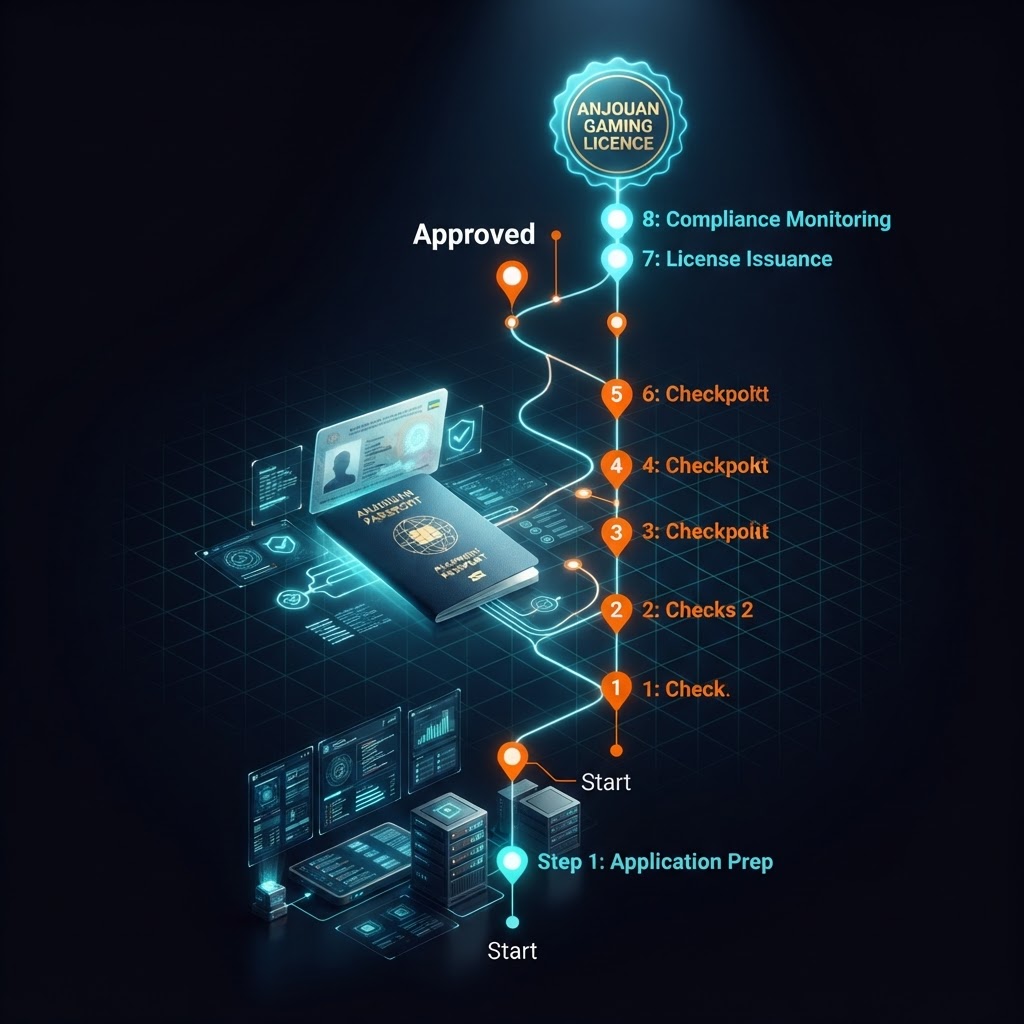
How to Get an Anjouan Gaming Licence in 2026: Step-by-Step Process, Documents and Timeline
An Anjouan gaming licence takes six to fourteen weeks and costs €25,000–€38,000 in year one on the direct route. Almost none of that time is the regulator. It is document collection, certification and correcting a file that was submitted incomplete.
This guide walks the process stage by stage, lists every document you will be asked for, and flags the specific errors that cause rejections — where the €17,828 application fee is non-refundable. It also covers the sub-licence route, which compresses the same outcome into two to four weeks at €9,000 per year.
Before you start: are you eligible?
The regulator will not licence you if you cannot clear due diligence on beneficial owners. Specifically, an application is at serious risk if:
- A UBO has an unspent criminal conviction, particularly for financial crime
- You cannot document the source of funds behind the business
- Your ownership structure runs through nominees or shell entities the regulator cannot look through
- A UBO is resident in a FATF-blacklisted jurisdiction
- Your target markets include jurisdictions on the restricted list
Any provider who tells you due diligence is a formality is either inexperienced or about to charge you a non-refundable fee for a file that will fail. Pre-screening is the single highest-value hour in this process.
Step 1 — Choose your licence class (1 day)
B2C covers operators running player-facing brands: online casino, live dealer, sportsbook, poker, lottery, esports. One licence, all verticals — you do not buy separately per product.
B2B covers platform providers, game studios, aggregators and technology suppliers serving licensed operators.
If you run your own brand and take player deposits, you need B2C.
Step 2 — Form the corporate vehicle (1–2 weeks)
For a direct licence you need a corporate entity in place before the application is filed — typically an Anjouan or Comoros International Business Company. Budget €2,000–€4,500 for formation and €1,200–€2,500 annually for registered agent and corporate maintenance.
You will need, apostilled or certified:
- Certificate of incorporation
- Memorandum and Articles of Association
- Register of shareholders, issued within 3 months
- Register of directors, issued within 3 months
- Company registry extract
- Certificate of good standing
- Certificate of incumbency
On a sub-licence, this entire step disappears. No gaming entity to form, fund or maintain.
Step 3 — Assemble the due-diligence file (1–3 weeks, and this is where timelines break)
For every director, shareholder and ultimate beneficial owner:
| Document | Notes |
|---|---|
| Certified passport copy | Certified by lawyer, notary or certified accountant |
| Proof of residential address | Utility bill or bank statement, dated within 90 days |
| Police clearance certificate | Order this on day one — some countries take 4–6 weeks |
| Signed CV | Ink signature, full employment history |
| Bank reference | From an institution with a 2+ year relationship |
| Professional reference | Lawyer or accountant, 2+ year relationship |
| Source-of-funds declaration | Must be documented, not asserted |
| Remote identity verification | Live video verification session |
The certification rules that cause most rejections:
- Certified copies must be issued by a lawyer, notary or certified accountant, with the certifier's full name, professional title and contact details on the document
- All documents in English, or accompanied by a certified translation
- Wet-ink signatures only. Electronic signatures are not accepted — this catches out more applicants than any other single rule
- Everything dated within the validity windows above at the point of submission, not at the point you collected it
Complex ownership structures — layered holdings, trusts, multiple corporate shareholders — attract an additional due-diligence charge and extend review time.
Step 4 — Prepare technical and operational compliance (1–2 weeks, in parallel)
Run this alongside Step 3 rather than after it.
Domain ownership. Documentary proof you control the domain the licence will cover. Additional domains cost €500 each.
Game content and RNG certification. A list of your game content with RNG certificates from a recognised test laboratory. If you are using an aggregator, they supply these — request them early, as it is rarely instant.
Terms and conditions. Must explicitly cover underage gambling prevention, responsible gambling, KYC procedures and self-exclusion. Generic templates lifted from another operator are visible and get flagged.
AML/CFT policy. Customer due diligence thresholds, enhanced due diligence triggers, transaction monitoring, suspicious activity reporting, record retention.
Responsible gambling tooling. Deposit limits, loss limits, session limits, reality checks, self-exclusion and a cooling-off mechanism — implemented in the product, not just described in a policy.
Geo-blocking. Configured and evidenced for every restricted jurisdiction. Stating it in your terms is not sufficient.
ADR provider. From 2026, licensees must designate an approved alternative dispute resolution provider for player complaints. Source and contract this before submission — €1,000–€3,000 per year.
Step 5 — Submit through an authorised service provider (1–3 days)
Applications are filed through authorised service providers, not directly by the applicant. The application fee of €17,828 is payable on submission and is non-refundable regardless of outcome.
This is the moment your capital is at risk. Do not submit an incomplete file to "start the clock" — a file returned for missing documents does not restart faster than a file submitted correctly two weeks later.
Step 6 — Regulator review (2–4 weeks)
The Authority reviews corporate structure, UBO due diligence, source of funds, technical and compliance documentation, and target-market configuration. Expect at least one request for clarification; respond within days rather than weeks, because the clock effectively pauses while you do.
Step 7 — Issuance and go-live (3–7 days)
On approval you receive the licence certificate and licence reference, register your approved domain, and display the licence seal and reference on your site. The licence is valid for 12 months and renews annually at €17,828.
Not sure your file will clear due diligence? We pre-screen structures before anything is submitted, so no non-refundable fee goes out on an application that will fail. Book a demo →
Total timeline, realistically
| Stage | Duration |
|---|---|
| Licence class selection | 1 day |
| Company formation | 1–2 weeks |
| Due-diligence file assembly | 1–3 weeks |
| Technical and compliance prep | 1–2 weeks (parallel) |
| Submission | 1–3 days |
| Regulator review | 2–4 weeks |
| Issuance and go-live | 3–7 days |
| Total | 6–14 weeks |
The five mistakes that cost applicants the most
- Ordering the police clearance certificate last. In several countries it takes four to six weeks. Order it on day one, for every UBO, before anything else.
- Using electronic signatures. Rejected. Every time. Wet ink only.
- Letting documents expire in the file. A utility bill collected in week one is 90 days old by the time a slow application reaches submission. Re-collect before filing.
- Submitting an incomplete file to save time. It saves none and puts a non-refundable fee at risk.
- Treating geo-blocking as a policy statement. It is a technical control the regulator expects to be implemented and evidenced.
The faster route: sub-licensing
If the process above reads as a lot of capital and calendar for a brand that has not proven itself yet, that is a reasonable reading. It is why sub-licensing exists.
Under a NexGrate Anjouan sub-licence, you operate under an established master licence's regulatory framework. Steps 2, 5, 6 and 7 disappear entirely. Step 4 is provided as a working compliance stack rather than a document set you have to build.
| Stage | Duration |
|---|---|
| UBO due diligence and onboarding | 3–10 days |
| Brand and domain approval | 2–5 days |
| Platform configuration and compliance setup | 5–10 days |
| Total | 2–4 weeks |
€9,000 per year, all in. No incorporation, no non-refundable application fee, no key-person charges, no separate renewal invoices.
Due diligence on your beneficial owners still applies — that is not a corner anyone should cut, and no credible provider will.
Frequently asked questions
How long does an Anjouan gaming licence take? Six to fourteen weeks for a direct application, of which two to four weeks is regulator review. A sub-licence takes two to four weeks end to end.
Do I need a company before I apply? For a direct licence, yes — an Anjouan or Comoros IBC must exist before submission. A sub-licence requires no separate gaming entity.
Can I apply for an Anjouan licence myself? No. Applications must be filed through an authorised service provider.
Is the application fee refundable if I'm rejected? No. The €17,828 fee is non-refundable regardless of outcome. This is the strongest reason to pre-screen your file.
What documents cause the most delays? Police clearance certificates and bank references. Both depend on third parties with their own timelines. Order them first.
Do I need separate licences for casino and sportsbook? No. A single B2C licence covers casino, live dealer, sportsbook, poker, lottery and esports.
How long is the licence valid? Twelve months, renewable annually.
What are the ongoing obligations after issuance? AML/KYC procedures and transaction monitoring, responsible gambling enforcement, a designated ADR provider, annual compliance reporting, maintained geo-blocking, and data security and player protection measures.
Skip six weeks of paperwork
NexGrate handles Anjouan sub-licensing and gives you the platform to launch on: 5,200+ casino games, full sportsbook, 25 languages, 300+ cryptocurrencies, compliance tooling built in. €9,000 a year, live in weeks.
Related reading: Anjouan Gaming Licence Cost in 2026 · Anjouan vs Curaçao in 2026 · Cheapest Gambling Licences in 2026
General information, not legal advice. Confirm current requirements with a licensed advisor before committing capital.