
You're probably in one of two situations right now. Either you already run casino or sportsbook products and want to add poker without creating an operational mess, or you're evaluating poker as a standalone launch and discovering that the software decision is much bigger than choosing a game skin.
That's where most new operators get misled. They shop poker game software as if they're buying a front-end product. In practice, they're choosing an operating system for liquidity, payments, fraud controls, player segmentation, game integrity, and regulatory execution. If the stack is weak, the lobby can still look polished while the business under it struggles.
The opportunity is real. The global online poker game software market was valued at approximately USD 6.2 billion in 2025 and is projected to reach USD 20.1 billion by 2035 at a 12.5% CAGR, according to Custom Market Insights' online poker market projection. But growth in the market doesn't protect an operator from poor vendor choices, bad assumptions about features, or a launch plan that ignores how poker ecosystems behave.
Table of Contents
- What Is Poker Game Software? A Guide for Operators
- The Core Architecture of Modern Poker Platforms
- Choosing Your Poker Software Deployment Model
- Essential Technical and Operational Considerations
- Navigating Compliance and RNG Certification
- A Strategic Checklist for Vendor Selection
- Launch Roadmap and Key Performance Indicators
What Is Poker Game Software? A Guide for Operators
For an operator, poker game software isn't just the thing that displays cards, avatars, and betting buttons. It's the full commercial and technical framework that allows a poker room to run legally, settle hands correctly, move funds safely, manage player behavior, and keep games active.
At a minimum, that ecosystem includes the game engine, the player account system, wallet and cashier flows, tournament and table management, fraud controls, reporting, and jurisdiction-specific compliance tooling. If any one of those pieces is weak, poker turns into a support problem fast. Players notice inconsistencies in hand flow, balances, late tournament registration rules, bonus edge cases, and reconciling deposits long before they appreciate visual polish.
Operators also need to think differently about poker than casino. Slots can survive with content breadth and acquisition spend. Poker depends much more on ecology. That means liquidity management, seat availability, fair game matching, table configuration, and retention mechanics have to work together. Software choices directly affect those outcomes.
A business system, not a content widget
A lot of first-time buyers make the same mistake. They ask, “How many game types do you support?” before they ask, “How does the platform handle player wallets, session states, disputes, KYC triggers, and game integrity?”
Those latter questions matter more.
Practical rule: If a vendor sells poker like a skin pack, assume you'll discover the real complexity after signing.
The better way to define poker game software is this: it's the operator-facing infrastructure that runs the room, not just the player-facing application that presents it.
What operators are actually buying
When you evaluate a platform, you're really buying five things:
- Game integrity: The software must run rules consistently and support fair outcomes.
- Operational control: Your team needs back-office visibility into tables, tournaments, balances, and exceptions.
- Commercial flexibility: Promotions, rake structures, and segmentation can't require engineering every time.
- Regulatory readiness: KYC, AML, auditability, and responsible gaming controls have to exist in the product.
- Scalability: The room has to stay stable as player traffic, tournaments, and payment events increase.
That's the baseline. Everything else is secondary.
The Core Architecture of Modern Poker Platforms
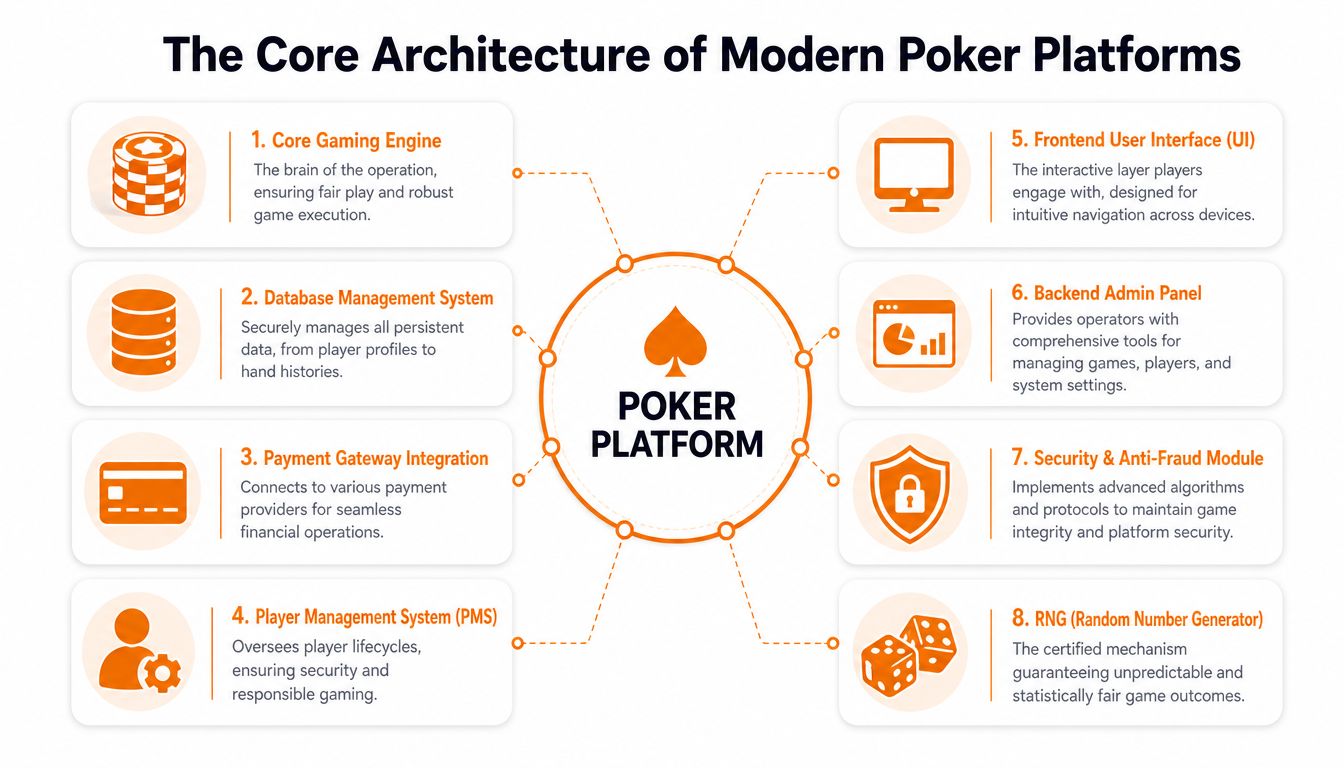
Most operator problems start when decision-makers treat architecture as a developer concern instead of a commercial concern. In poker, architecture determines whether players trust the room, whether tournaments stay synchronized, and whether support teams spend their day resolving preventable disputes.
Online poker software relies on a client-server architecture where the client handles the interface and request transport while the centralized server manages game logic, connection states, and round validation across simultaneous sessions, as described in this overview of online poker architecture internals. That division is why the server, not the visual client, is the core of the product.
Why the server matters more than the table design
Think of a physical poker room. The felt, chips, and table signage matter, but they don't enforce the rules. The dealer and floor staff do. Online, the server plays both roles.
The server validates actions, tracks blinds, enforces betting sequences, resolves all-ins, handles disconnect states, closes hands, updates balances, and records the outcome. If that logic sits anywhere else, you invite inconsistency. A client should never be trusted to determine whether a hand was legal or what a player won.
That's why mature vendors talk in terms of state control, validation, reconciliation, and failure handling. Immature vendors talk mostly about the lobby.
A smooth UI can hide weak infrastructure for a while. It can't hide mis-settled tournaments or broken reconnect logic.
The components operators should understand before buying
The easiest way to assess a stack is to map it to the equivalent functions inside a real casino operation.
Core gaming engine
This is the dealer and floor manager combined. It enforces rules for cash games, tournaments, blinds, antes, betting rounds, side pots, folds, showdown resolution, and seat states. Operators should ask how exception handling works, especially around disconnects, abandoned seats, and tournament transitions.
RNG and fairness controls
The RNG is the shuffler. It must produce unpredictable and defensible outcomes. In commercial terms, this is what protects trust when players question streaks, hand distributions, or suspicious gameplay narratives.
Frontend client
The client is the table, chips, and visual interface. It affects usability, session length, and how comfortable players feel multitabling across devices. This includes desktop, browser, and mobile experiences.
Player management system
This is the membership desk plus responsible gaming desk. It handles registration, authentication, player states, limits, verification triggers, segmentation, and account lifecycle controls.
Wallet and payment layer
This acts as the cashier cage. It handles deposits, withdrawals, transfer states, balance updates, bonus interactions, and reconciliation with payment providers. If wallet logic is fragile, support costs rise quickly.
Back-office and admin tooling
This is your surveillance room and operations desk. Good tooling lets your team monitor tables, investigate disputes, adjust configurations, review suspicious behavior, and export operational reports without waiting on engineering.
Security and anti-fraud modules
This layer watches for collusion, bot-like patterns, abuse of bonuses, chargeback exposure, account linking, and suspicious financial behavior. Operators often underweight this area until player complaints appear.
Database and hand history management
This is your evidence archive. It stores player records, balances, actions, outcomes, and logs. If a vendor can't show clean hand-history access and traceability, dispute resolution becomes painful.
A useful shortcut is to review whether the vendor can explain how these pieces connect in plain language. If they can't, you'll likely feel that same opacity after launch. For operators comparing broader iGaming stacks with integrated backend capabilities, it helps to review an example of a unified gaming platform architecture before narrowing down poker-specific requirements.
Choosing Your Poker Software Deployment Model
Operators usually enter the market thinking they need “the best poker software.” The sharper question is simpler: what operating model can your team support? That answer determines whether white-label, turnkey, or custom development is the right path.
The biggest mistake here is confusing ownership with control. Some teams chase custom builds because they want full control, then discover they've also signed up for vendor management, technical debt, compliance dependencies, QA overhead, and a much slower route to launch.
Three routes to market
White-label is the fastest route when you need to launch under your own brand without building the platform core yourself. You get limited flexibility, but the vendor usually standardizes enough of the stack to keep implementation manageable. This model works when speed matters more than deep product differentiation.
Turnkey gives you broader control over branding, configuration, integrations, and operations while still relying on a prebuilt core. In practice, this is the sweet spot for many operators because it avoids the burden of building game logic and compliance foundations from scratch.
Custom development gives you the most ownership and the most responsibility. It only makes sense if you have a clear product thesis that can't be expressed through an existing platform, plus a team that can manage architecture, certification work, maintenance, and long-term iteration.
The development of scalable, real-money poker platforms in regulated markets typically takes 4 to 15 months and $10,000 to $50,000, according to Creatiosoft's breakdown of multiplayer poker development timelines and costs. That range should immediately reset expectations for operators who assume a custom path is just a branding exercise.
Poker Software Deployment Model Comparison
| Factor | White-Label Solution | Turnkey Solution | Custom Development |
|---|---|---|---|
| Time to market | Fastest path | Moderate | Slowest path |
| Upfront investment | Usually lower | Moderate | Highest operational burden |
| Brand control | Limited to approved customization | Stronger control over brand and setup | Full control if you build it well |
| Feature flexibility | Constrained by vendor roadmap | Broader configuration and integrations | Maximum flexibility with internal resources |
| Technical burden | Mostly vendor-side | Shared between vendor and operator | Primarily operator-side or outsourced |
| Compliance workload | Often partially standardized | More configurable but still assisted | Must be designed and documented in detail |
| Best fit | Fast market entry | Operators wanting control without full build risk | Teams with a genuine product and engineering edge |
A second test helps clarify the choice. Ask your team who will own the post-launch realities: cashier exceptions, fraud review, payment routing changes, tournament configuration, mobile QA, and jurisdictional updates. If the answer is vague, custom is usually the wrong decision.
For operators comparing packaged launch models, a turnkey and white-label product stack for iGaming operations is useful as a benchmark for what should already be integrated before you ever discuss custom development.
Essential Technical and Operational Considerations
The market's growth is tied to smartphone adoption and real-money gaming usage, which has pushed platforms toward secure, user-friendly architectures that also support features such as crypto deposits and live-dealer aggregation, according to SNS Insider's online poker market report. For operators, that has a direct implication. Poker software can't be evaluated as a desktop-first product with mobile compatibility added later.
Mobile first changes the product brief
Mobile changes how players register, deposit, browse tables, join tournaments, and resume interrupted sessions. It also changes support volumes. Small UI issues that feel minor on desktop become expensive on mobile because players abandon flows faster and create more cashier and login tickets.
That means mobile product work isn't just about responsive design. Operators need to verify:
- Lobby usability: Can players filter games, stakes, and formats without friction on a smaller screen?
- Cashier continuity: Does the deposit and withdrawal flow remain stable when users switch apps, tabs, or network conditions?
- Session recovery: Can the client handle reconnects cleanly during active hands or tournament play?
- Table readability: Are betting controls, stack sizes, and action prompts still clear during multitabling or portrait-mode use?
A room that “supports mobile” isn't necessarily a room that performs well on mobile.
Where operations usually break
Latency is one of the first hidden problems. Players won't describe it as latency. They'll say the software feels off, actions feel delayed, or tables feel unreliable. In poker, that perception matters because timing affects confidence in fairness and willingness to continue playing.
Scalability is the second problem. A platform may run fine in routine conditions and then struggle during promotions, tournament peaks, or bursts of deposit activity. Operators should ask how the vendor handles concurrent session growth, state synchronization, and table creation spikes.
Security is the third. In poker, fraud isn't just stolen credentials. It includes collusion, bot behavior, abusive bonus usage, linked accounts, and manipulated payment behavior. If anti-fraud tools sit outside daily operations instead of inside them, teams react too late.
Operational warning: Don't separate product decisions from fraud decisions. In poker, they affect the same player lifecycle.
Live-dealer adjacency matters too, even if your poker room isn't itself a live-dealer product. Players increasingly move across casino, live, and poker environments within one account journey. If the broader platform can't support that movement cleanly, retention suffers and wallet usage fragments.
A strong operator evaluates these areas through real workflows, not feature sheets. Open account, deposit, join a table, disconnect, reconnect, enter a tournament, trigger a manual review case, withdraw, and inspect the logs. That test tells you more than a polished demo ever will.
Navigating Compliance and RNG Certification
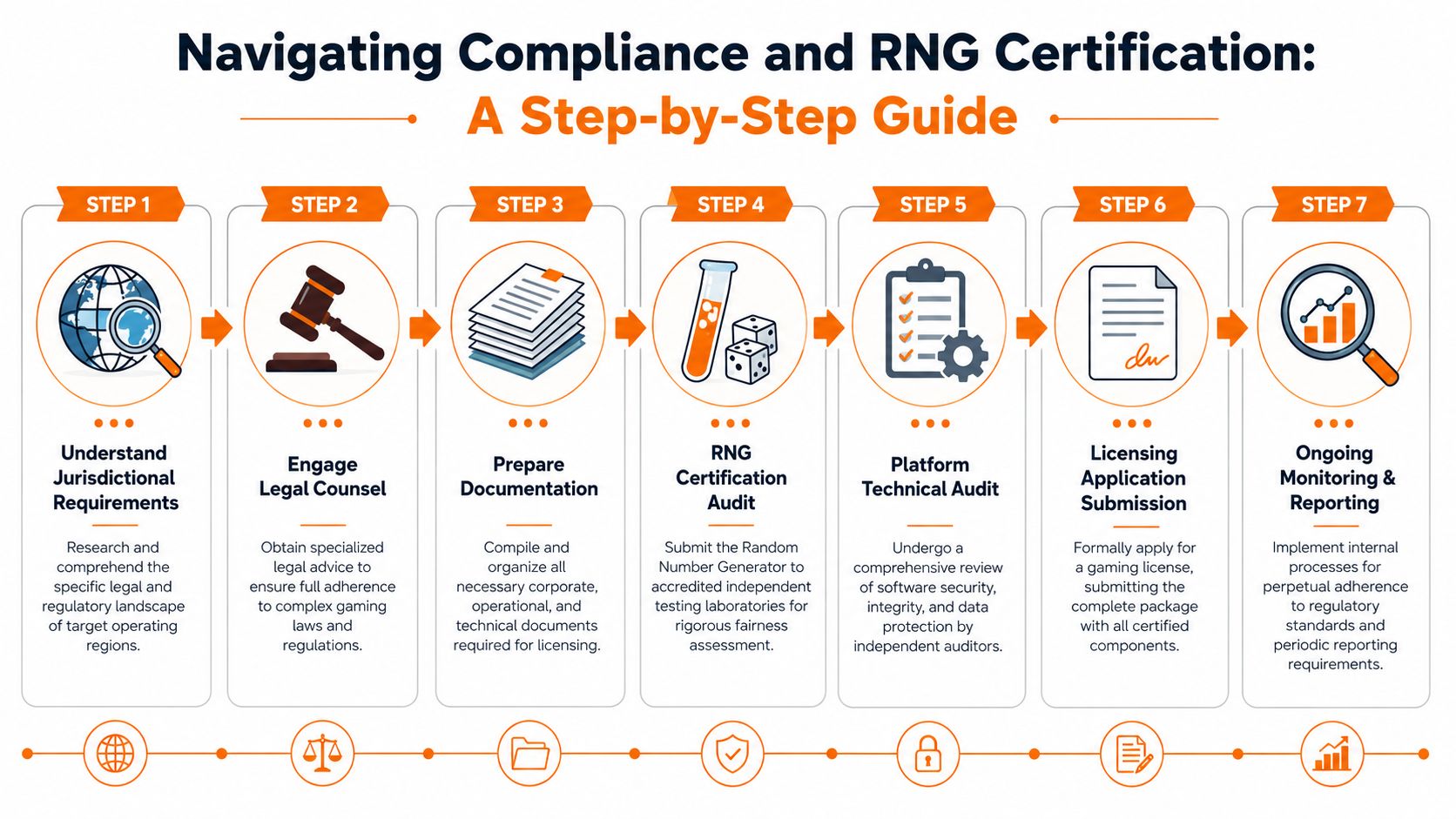
Compliance is where weak poker businesses get exposed. Not because regulation is hostile, but because regulation reveals whether the platform was built as a real-money operating system or dressed up after the fact.
If your software can't support auditable player management, transaction traceability, hand-history review, responsible gaming controls, and jurisdiction-specific restrictions, the licensing process becomes slower, more expensive, and harder to defend. Even before licensing, those gaps create internal problems. Support teams can't resolve disputes properly. Finance teams can't reconcile exceptions. Risk teams can't demonstrate why a decision was made.
Compliance starts in the platform design
The right way to think about compliance is operationally. The software must make compliant behavior normal.
That means the platform should support documented KYC and AML workflows, account restriction controls, reporting access, and clear administrative permissions. It should also preserve enough event history that teams can reconstruct a decision path later. If a vendor's compliance story depends too much on manual workarounds, you're taking on risk that scales with player activity.
This video gives a useful overview of what a structured certification mindset looks like in practice.
What to verify before licensing work begins
Start with the RNG. Operators don't need to become testing specialists, but they do need to confirm that the randomness component can be independently assessed and documented for the jurisdictions they plan to enter. If the answer is vague, treat that as a major issue.
Then inspect the surrounding controls.
- Player account management: Can you apply identity checks, account limits, and status restrictions in a controlled way?
- Audit logs: Can your team trace who changed what, when, and why?
- Responsible gaming settings: Are limits and interventions native to the system or patched in externally?
- Reporting support: Can you export the operational and compliance data regulators typically expect?
- Geographic and jurisdictional controls: Can the platform adapt to different market requirements without rewriting core logic?
Compliance isn't a legal layer sitting above the product. It's a set of product behaviors the software must enforce every day.
A useful due-diligence step is to ask the vendor to walk through a failed withdrawal review, a suspicious play review, and an account restriction event inside the back office. That exposes whether the compliance toolkit is usable by operations staff or just impressive in sales material.
If your team is evaluating broader regulatory readiness across casino, sportsbook, wallets, and reporting workflows, review a gaming compliance toolkit built for operational use and compare it against the poker-specific controls your jurisdiction requires.
A Strategic Checklist for Vendor Selection
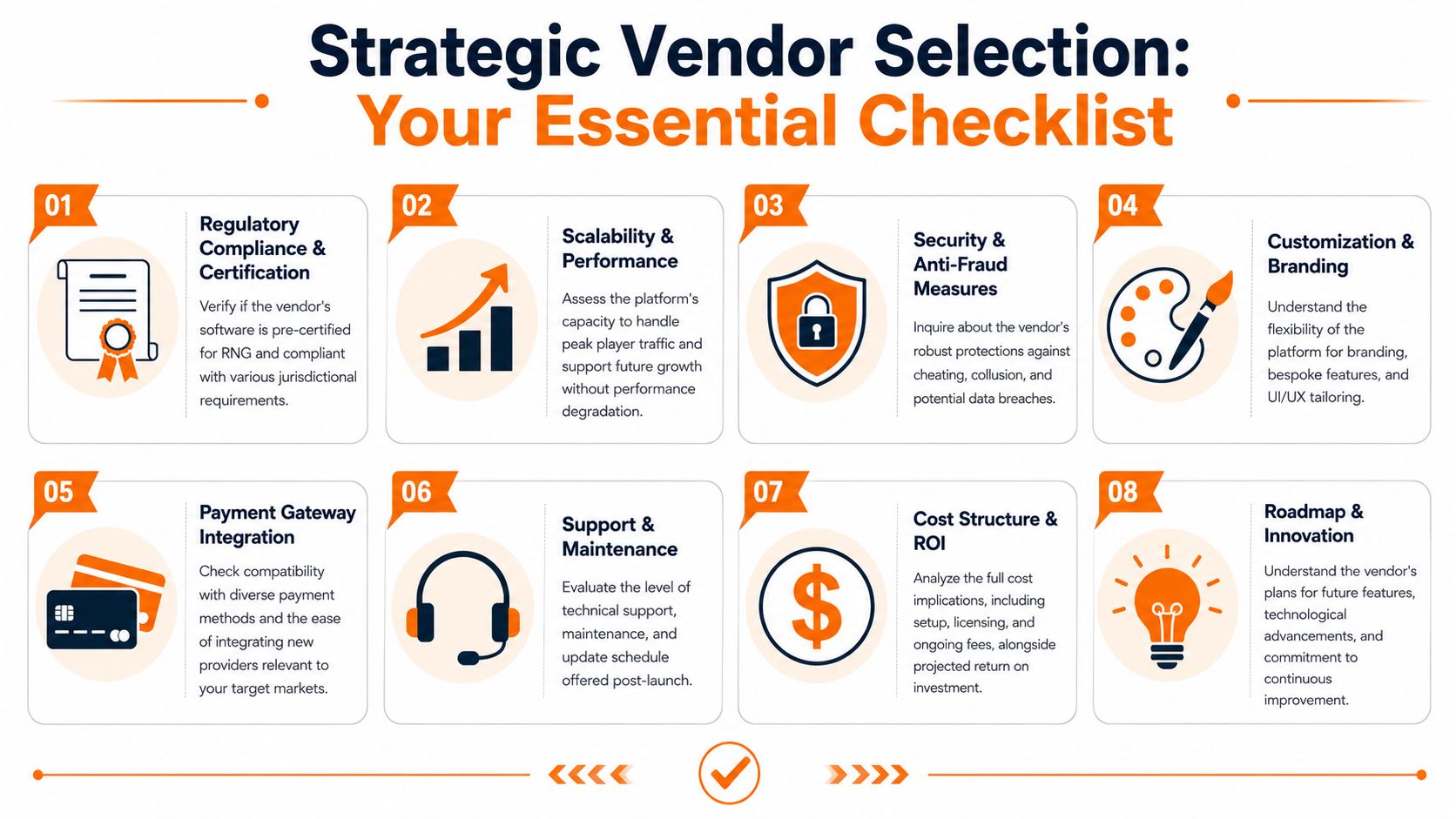
Vendor selection gets easier once you stop asking, “Who has the most features?” and start asking, “Which claims survive operational scrutiny?” That shift matters because poker vendors often present configurable features as if they're automatic outcomes.
The best example is table selection. Operators often assume the platform will instantly optimize player placement, retention, and game quality by default. Providers have pushed back on that assumption, noting that table selection must be planned carefully and isn't a guaranteed out-of-the-box promise, as explained in EvenBet Gaming's discussion of poker feature misconceptions.
Questions that expose marketing gaps
Use the sales process to force specifics. General assurances aren't enough.
- Ask about configuration ownership: What exactly must your team configure post-launch for table selection, tournament settings, limits, and retention features to behave as advertised?
- Ask about technical limitations: In what situations does the feature not work as expected, or require manual intervention?
- Ask about data dependencies: Does optimization depend on liquidity levels, segmentation logic, or behavioral rules you must define?
- Ask about exception handling: What happens when a player disconnects, disputes a hand, or gets flagged for suspicious behavior mid-session?
- Ask about roadmap boundaries: Is a requested feature already in production, on the roadmap, or merely possible through custom work?
These questions sound basic, but they change the tone of the entire procurement process. Serious vendors answer directly. Weak vendors drift back into demo language.
What strong vendor answers sound like
A strong answer includes prerequisites, dependencies, and limits. For example, on table selection, a credible vendor might say that the feature depends on your liquidity strategy, game format mix, and operator-defined rules, and that it needs tuning after launch based on traffic behavior.
A weak answer skips that complexity and promises a business result instead of a product capability.
Don't buy retention claims. Buy workflows, controls, and evidence that your team can operate them.
I'd also push vendors on support maturity. Ask who handles urgent incidents, how release notes are shared, how regressions are tested, and whether the product team understands poker-specific operational edge cases. The answer will tell you whether they've actually run real-money environments or just sold into them.
A practical checklist for diligence looks like this:
- Request a back-office walkthrough using real operational scenarios, not a surface demo.
- Review hand-history traceability and dispute resolution paths.
- Test cashier and wallet edge cases across deposits, withdrawals, reversals, and restrictions.
- Inspect mobile behavior under normal and interrupted sessions.
- Verify compliance tooling from an operator user's perspective.
- Clarify feature ownership so you know what's configurable, custom, or unavailable.
- Check post-launch support including maintenance cadence and incident handling.
- Document every promise in contractual language, especially around integrations and delivery responsibilities.
That process doesn't eliminate risk, but it does expose fantasy.
Launch Roadmap and Key Performance Indicators
Launches fail when operators treat go-live as the finish line. In poker, launch is just the start of learning whether the room's configuration, ecology, and support processes work under real behavior.
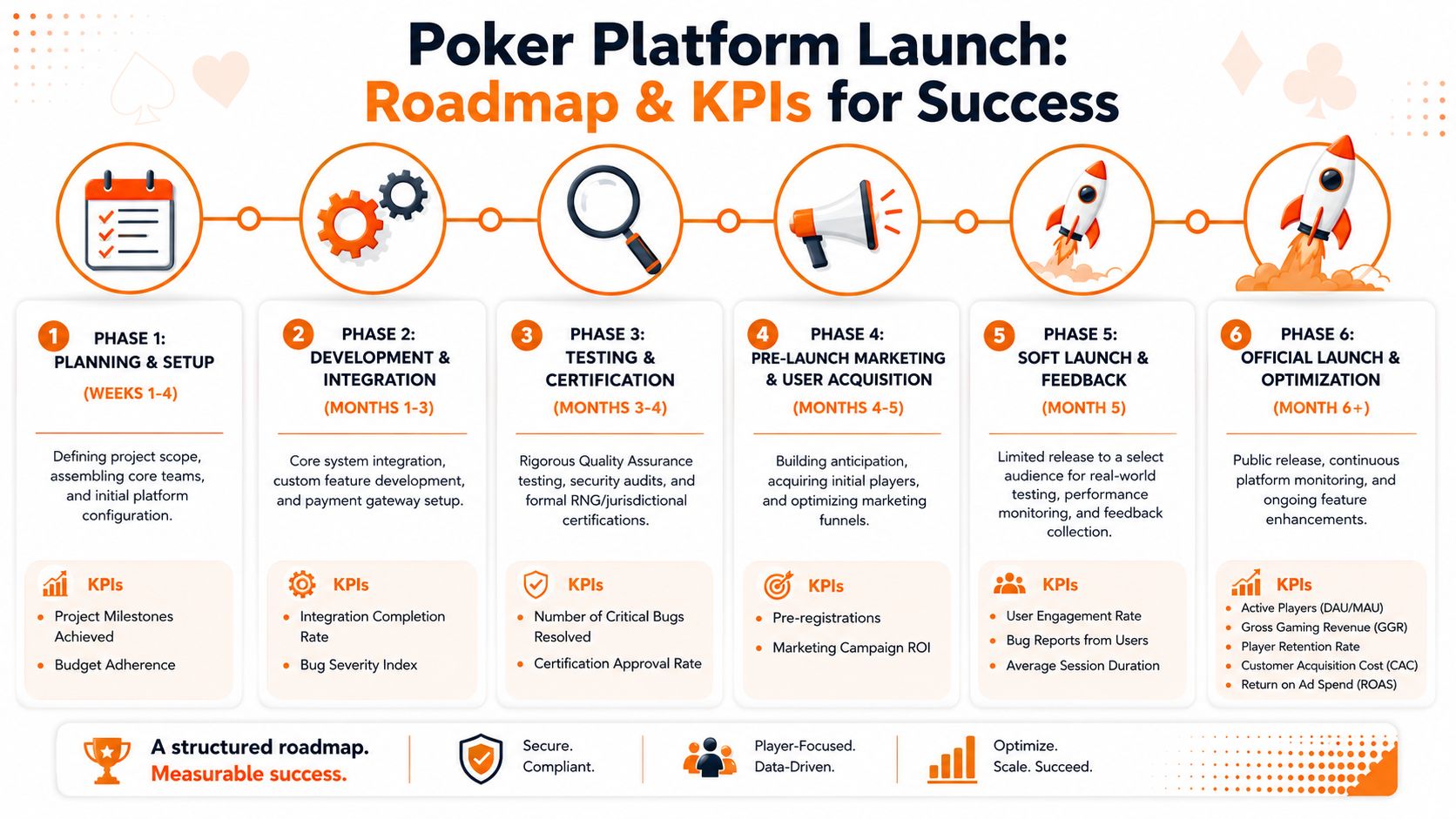
A better launch plan is staged. First align on operating model, then configure the platform, then test the edge cases, then release to a controlled audience, then scale acquisition once you know the room behaves as intended.
A practical launch sequence
The rollout usually works best when broken into distinct operational phases rather than one giant project stream.
Planning and commercial setup
Define jurisdictions, payment scope, operating roles, support ownership, fraud review workflows, and the product boundaries for launch. This is also where many teams discover they were relying on assumptions rather than written requirements.
Integration and configuration
Connect payments, reporting, CRM or bonus tooling, account systems, and any shared-wallet dependencies. Then configure stakes, table rules, tournament templates, permissions, and responsible gaming settings.
Testing and acceptance
Run more than functional QA. Test interrupted sessions, duplicate requests, reversal flows, delayed payment statuses, player restrictions, tournament late registration, and suspicious activity reviews. The point is to see whether operations can manage the room.
Soft launch
Open to a limited audience and watch behavior closely. Don't spend aggressively on acquisition before you know where players drop, what support tickets cluster around, and whether liquidity assumptions hold.
Public launch and iteration
Only after those checks should you scale. At that stage, product and operations need a weekly review loop, because the first real lessons will come from player behavior, not planning documents.
KPIs that actually help you run poker
Many operators track headline revenue and little else. That's not enough for poker, where traffic quality and game ecology matter as much as top-line performance.
Track these categories consistently:
- Gross Gaming Revenue and Net Gaming Revenue: These are essential commercial baselines. They tell you what the room is producing before and after the relevant deductions in your operating model.
- Rake per hand and tournament fee contribution: Useful for understanding which formats are sustaining the room and whether table inventory aligns with player demand.
- Active players: Daily and monthly active patterns help you spot whether traffic is broadening or just recycling the same cohort.
- Retention rate: Poker rooms live or die on repeat participation. If players don't return after initial deposit activity, the issue is usually product friction, weak liquidity, or poor game availability.
- Average player value: This helps separate high-volume recreational behavior from low-value acquisition noise.
- Customer acquisition cost and return on ad spend: Especially important once paid growth begins. If your economics only work during promotions, the room needs adjustment before scaling further.
- Support and risk indicators: Dispute frequency, withdrawal review friction, and suspicious play alerts often reveal operational problems before revenue dashboards do.
One practical rule helps here: don't interpret KPIs in isolation. Rising deposits with falling retention usually signal experience issues. Strong active users with weak rake often signal poor format mix or passive players without enough game participation.
The operators who build durable rooms are the ones who treat launch as the beginning of disciplined iteration, not the end of procurement.
If you're evaluating how to launch or expand an iGaming brand with less integration overhead, NexGrate offers a turnkey white-label platform that brings together games, sportsbook, payments, back office, and compliance controls in one operating stack. It's built for operators who want to move faster without stitching together a fragmented set of vendors.